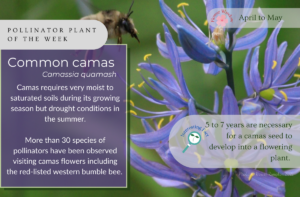
Pollinator Plant of the Week: Camas
Common camas (Camassia quamash) is a wildflower native to western North America, specifically found in regions like the Pacific Northwest and the Great Basin. It is a member of the Asparagaceae family.
The plant is a perennial herb that grows to a height of 20-80 cm (8-31 inches). The stem is erect and unbranched, and is covered in fine, glandular hairs. The leaves are basal, lanceolate to linear, and measure 20-40 cm (8-16 inches) long and 1-3 cm (0.4-1.2 inches) wide. They are dark green in color and have a smooth texture.
The flowers of Common camas are showy, with clusters of blue, purple, or white flowers that measure 1-2 cm (0.4-0.8 inches) wide. They are arranged in a terminal inflorescence and typically bloom from late spring to early summer.
The fruit of Common camas is a capsule that measures 1-2 cm (0.4-0.8 inches) long and contains several small, black seeds. The seeds are dispersed by wind and are able to survive in the soil for several years before germinating.
Common camas is an important source of nectar for pollinators, and its showy flowers make it a popular ornamental plant in gardens. It is also an important food source for native animals, such as bears, deer, and elk. Camas bulbs were also an important food source for indigenous people in the Pacific Northwest. It prefers well-drained soils and is drought tolerant, making it well suited for xeriscaping and other dry landscaping.
This is a native plant that is very near and dear to us at KNPS.